7 September 2026
Guest blog – How to up-skill in the age of AI and get ahead in the job market
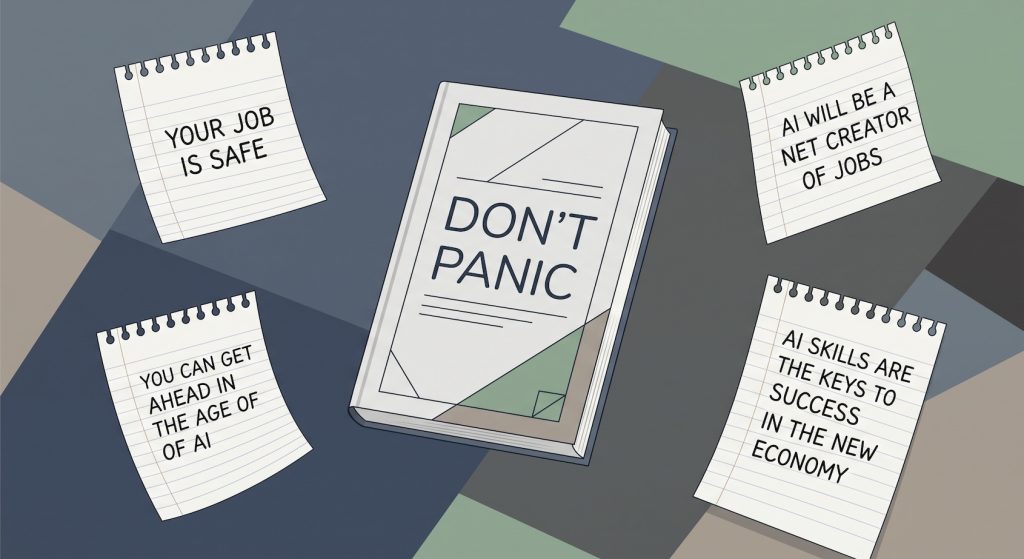
Don’t Panic
There is a deluge of clickbait crap flying around at the moment with the message “AI will take everyone’s jobs”.
This is scaremongering, because it is not true.
And it is manipulative, because it is designed to get you to click on the article and thus generate revenue for the author.
Andrew Ng (the founder of Google Brain, and of deeplearning.ai ) has said multiple times that AI will not take your job. AI looks super impressive these days, but it is still nowhere near the level it needs to be to replace humans. In articles over the last 2 years Andrew has pushed the argument that AI will be a net creator of jobs; albeit those jobs will be for people with AI skills.
The authors of “Vibe Coding” say the same thing: each new technologic advancement has increased employment rather than decreased it.
BUT, what is happening is that organisations everywhere are starting to pivot to a “copilot economy”, where human work is assisted by agentic AI.
There is truth to the saying “AI will not take your job, but a person who can use AI will take it”
The coming skills shortage
Surveys conducted by the WEF in 2025 have shown that 66% of organisations are planning on hiring staff with AI skills in the coming years.
Well, that’s a lovely idea…. but where are they going to find all these AI trained staff??
Because right now there is a massive skills shortage. The technology has evolved so fast that organisations have struggled to adapt in response. They know that they need to hire trained staff, but:
- C-suites don’t know what those skills are
- HR doesn’t know what keywords to put in job ads
- recruiters don’t know how to screen candidates for AI skills
- department heads aren’t sure how AI will fit into their work processes
It’s the blind leading the blind. Organisations everywhere want “more AI” and are willing to pay premium salaries for staff with the skills. If only they could find them.
And right now, only a few thousand people in the UK have upskilled enough to tackle this work!
Another glass ceiling?
At the Data and AI Summit in 2025 Jamie Dimon (the head of JP Morgan Bank) said that one of the first questions he asks his direct reports at their appraisals is “how many AI agents have you built this quarter?” Note: the question was not “how many have your underlings built?” or “how many have been built in your departments?”. The question to C-suite execs was “how many have you built?”
The implication in this question is: “if you are not building agents (i.e. you are trying to do all your work manually) then why am I paying you when I could pay someone who produces 10x the work by making use of AI?”. AI is not just going to affect non-management roles… it is going to affect all roles right up to the boardroom. If you miss the AI boat, you are absenting yourself from the top spots.
Thankfully not all industries are as cutthroat as it is at the pinnacle of JP Morgan, but what happens there today will trickle down in the coming years.
Anyone who cannot automate large parts of their work will get sidelined and promoted over by someone who understands AI automations and how to use them effectively in the workplace.
What skills?
So what are the skills that are going to be in demand in the new era of AI?
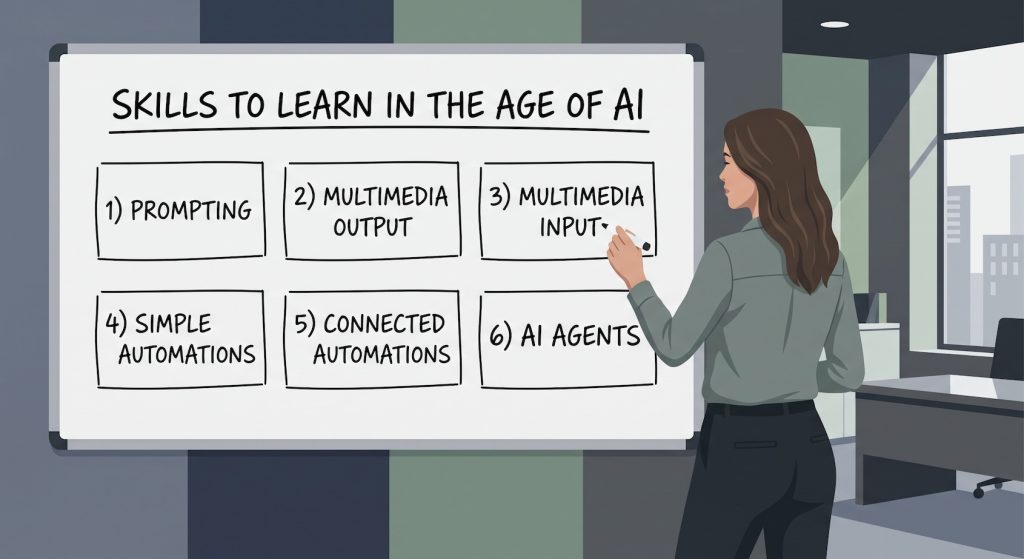
In no particular order, these skills include:
- prompting
- generating different types of output (prose, audio, images, video)
- working with multimedia input (voice typing, audio notes, images)
- simple automations
- more connected automations
- agents
Prompting
(also: prompt engineering, context engineering, tokenomics)
This is a level beyond just chatting with ChatGPT. Prompting is the art of giving an LLM a tuned, efficient prompt so that it returns exactly what you want; nothing more, nothing less. Prompt engineering extends this to repeatable prompts which typically run unattended and so need to be evaluated and cost-controlled up front.
Context engineering is knowing how not to bloat the message context, and strategies for compacting the context if it does get bloated.
Tokenomics is understanding the cost of tokens, having strategies to keep costs under control (including knowing which size model to use, and when), and having a way to monitor the cost and troubleshoot problems if costs spike.
The important point here is that no programming skills are needed here! Prompting is done in natural language – commonly in English, but it also works in many other languages if English is not your first language.
For tokenomics you don’t need maths skills, just the ability to tell when one number is higher than another.
Generating different types of output
This is the art and science of knowing what kinds of output are possible, and when to choose the correct type.
Simple text is the most common type of output, such as you would get when chatting with ChatGPT – you ask a question, and the LLM writes text as your answer. But other kinds of text are possible too, including longer prose, reports, charts and diagrams, images, audio, podcasts, JSON, computer code etc
There is a growing demand for skilled workers who know what kinds of output are possible, which AI models can produce which ones (and at what cost), and effective strategies for prompting those models.
Working with multimedia input
LLMs can ingest more than just the words you type in the chat prompt. Multimodal models can accept a voice note and transcribe the speech to text. Or accept a photo of a receipt and extract data like the date + time, vendor, receipt number, and amount.
When designing improvements to workflows it is no longer necessary to think purely in terms of human sitting at keyboards. Everyone carries a mobile phone in their pocket these days. AI savvy staff can spot the opportunities to use photos, videos, or voice notes to streamline business processes.
Simple automations
In the near future all knowledge workers will need the skills to automate routine tasks like:
- taming your email inbox
- drafting replies to emails (you still have to review the draft before sending it)
- wrangling calendars
- doing regular web search
- producing internal reports and metrics, along with commentary
- reviewing your own work and providing feedback
These are all productivity boosters for the individual which, if still done manually, are a drain on time for little value. These kinds of automation help free up time for the tasks that AI cannot yet do.
More connected automations
These automations are more complicated than the ones above because typically they involve either of:
- connecting AI tools together using REST APIs, MCP, webhooks
- building automations for your team instead of just yourself
An examples of this kind of automation is one where you create a trigger that watches for events on one system (e.g. team members updating their timesheets, or making a change to a project definition), and the automation uses an LLM to understand the change your colleague made and then carry out an action based on what it found (e.g. if the team member’s timesheet entries put more hours against a SoW than the budget allows, then the automation can take actions like send a Slack message to you, or make an entry in a spreadsheet to record the hours overspend. If the LLM has enough context about your project budgets and allocations then it could even automatically transfer hours from another project to cover the overspend? But this latter example would be best set up with a Human in the Loop guard!)
Another example of a more connected automation would be for onboarding staff. Typically this involves making updates to multiple systems, and/or sending emails to other departments asking them to get things ready for the new team member (HR systems, payroll systems, training systems, org chart, building pass, logins for various systems, laptop + phone requisition, etc) This is a textbook example of work which should be automated; it is repetitive, boring, prone to errors, and any errors can be potentially expensive if they mean a new staff member cannot hit the ground running on day 1. Once the core information about a new joiner has been added to the HR system, then an automation can trigger from that and update all the other systems that it can be connected to. Any systems which it cannot be connected to, or which involve manual steps like pulling a physical laptop out of storage, can still be accomplished by automating the email to that department.
When working with APIs, MCPs or webhooks an important skill is knowing how to store API keys safely. These should never be hardcoded, emailed around, or stored in plain text files! Instead they need to be kept in some kind of password manager, or secrets vault.
Agents
This is a natural extension of the more advanced automations mentioned above.
AI agents consist of:
- an LLM
- Tools which can interact with outside systems (often using MCP)
- a prompt that tells the agent what the intended goal is, and which Tools it has at its disposal
When an agent is invoked the LLM makes the decisions what to do, and in what sequence until the goal is met. It does not follow a pre-defined script. AI agents are smart enough to make a plan, and execute that plan on their own. They take steps in a loop, and evaluate the results until they decide that their job is done. Humans can observe the ‘thinking’ process, the steps taken, and the final output – but humans do not need to program an agent step-by-step.
The art of creating good quality agents is to be able to write prompts that describe the goal and the acceptance criteria in natural language, as well as concisely describing the Tools available and when to use them.
The final skill necessary when building agents is to know how to fine tune their token usage, troubleshoot when then go wrong, and review both the agent and the Tool output looking for errors.
How to learn these skills
Hopefully this blog post so far has convinced you of the need to learn how to take advantage of AI to automate your work and life. But the natural question at this point is “how do I go about learning AI automations?”

Broadly speaking there are 4 ways, none of which are mutually exclusive:
- follow online courses (YouTube, Udemy, deeplearning.ai, Skool communities)
- wait for your employer to offer training
- do a vendor certification
- get involved in an in-person community
Here is a quick breakdown of the pros and cons of each
| Option | Pros | Cons |
|---|---|---|
| Online courses | – available 24/7 – fits your schedule – free, or low cost – thousands available – if you know what you are looking for, there are some very good ones | – variable quality – plethora of AI slop – unverified content – tricky to know where to start – no realtime support, and limited overall support |
| Your employer | – course content pre-validated – free – tailored for your org tech stack | – few employers proactively training employees in 2026 – courses tend to be vendor-specific – not all employers even know what to train their employees in – some courses come with conditions (e.g. if the employee leaves within 12 months of completing the course then they have to reimburse the full cost) – just completing the course doesn’t guarantee that the employee will get to use the skills – there is a shortage of skilled AI trainers, so course delivery tends to be pre-canned with few opportunities to ask questions |
| Vendor certification | – industry recognition – can be taken to new employer – likely to be cutting edge – good support from vendor | – only applies to one vendor’s product(s) – although training is free, exam + certification costs sometimes have to be paid by the employee |
| In person community | – lots of realtime support – build connections with people on the same journey – attend talks by people who have pre-screened the tech – not limited to 1 vendor, or an employers tech stack – escape from social media for 2hrs – make friends – get involved in social activities outside of the meetup | – geographically limited – fixed time + day + place – transport |
From the table above it might look like we’re biased towards in-person community meetups. And you’d be right! 😄
Whereas all the other methods have their places, we believe that the strongest and most reliable way to get ahead in this new era of AI is to join in with other people on the same journey. In-person meetups give you the chance to chat with, swap study tips with, share success (and snafu) stories with and, best of all, make new friends at a time when human connection is harder to come by.
(shameless promotion alert…. 😉
Luckily for anyone living in Bristol there is already an active community studying this crazy AI stuff! The Bristol AI Automations meetup is an offshoot of Bristol Data Science and Machine Learning meetup, which is part of Women’s Tech Hub.
We are a friendly and welcoming bunch, and every month we host fascinating talks about the latest developments in AI and how to make practical use of them. Plus there are opportunities for discussion before and after each session, when you can ask any questions about any aspect of whatever you are learning.
Our next meeting is on Wednesday 16th September when we will be having a practical demo of WebMCP! This is a cutting edge technology that the mainstream has not caught on to yet; so come along and be in the advance party. WebMCP is already looking like it will be the “must have” skill for 2027 onwards.
If you’d like to attend the next meetup please RSVP HERE
At October and November meetings we will have a demo of building agents with Claude, and a demo of how to write top quality prompts to generate video content.
We hope to see you soon! 💖
Em and John
(co-organisers of Bristol AI Automations meetup)
‘Em and John’ are co-founders of Willowsail AI,a Bristol based AI automations consultancy. Both have a passion for ethical AI and want the upcoming era to be for the many, not just the few.”